Showing posts with label traits writing. Show all posts

Monday, May 5, 2014

Traits Tuesday Linky!: Using National Geographic Kids Readers as Mentor Texts


We are rekindling our Traits Tuesday Linky! Click our logo to learn all about it! Simply, share your writing ideas, resources, mentor texts, successes, student work, and MORE related to helping your students become authors.  ANYTHING GOES!  We would love for you to hop on board---we all have a school year full of goodies to share!  Don't have a blog, you can share in a comment!

Writing Traits
Ideas
Organization
Conventions
Sentence Fluency
Word Choice
Voice
Presentation

http://hootsnhollers.blogspot.com/p/traits-tuesday.html

Organization and Fluency
Using National Geographic Kids Readers

My students embarked on a wonderful research and writing journey some time ago, and the fruits of their labor have been amazing.  I will be sharing more details and student work in a future post...

In a nutshell, students have collaboratively researched and written informational animal texts.  For now, I would like to share how we used National Geographic Kids readers.

Bold Beginnings

As we know, bold beginnings, grabbing our reader's attention, or hooking the reader (whatever you want to call it) is essential.  To learn how authors achieve this goal in informational texts, we turned to various texts from our classroom library--ultimately we found National Geographic Kids readers to be effective, as they received the most votes from students.  

We explored how four different authors began their books related to the same topic, discussed their level of effectiveness (in comparison to the requirements we generated on our anchor chart), and then brought it to a vote. We did this with several topics.  Why were National Geographic kid readers a favorite?  The kids especially liked the creative questions, how the authors made them think, and how some used a riddle format.

Here are a few we found to have bold beginnings. 


The kids' beginnings turned out to be fabulous!  Samples will be shared soon...

Creative Headings

We went through a similar process in analyzing how different authors use headings.  AGAIN, Nat Geo Kid readers came out on top for their creativity and getting the reader to think about each main idea.  

Quickly, here are some of the headings my kids came up with for the various main ideas in their books--Fur Style (spider monkey's appearance), The Stripe Type (zebra's appearance), Oh, Baby! (snowy owlets), What's for Dinner? (African lion's diet)...

Student proved that they can lead by example, yet be original!

Sentence Fluency

Ponies was an excellent example of how an author begins sentences in different ways.  This was a great opportunity for the kids to see how what they have learned about using pronouns becomes most important when it is applied in the context of their writing.

We focused on the key details the author shared about foals by charting the varied sentence beginnings. We talked in depth about how important sentence variety is to the reader, specifically citing our own feeling when reading informational texts.  

I am sure you have notice the abundance of rich informational texts being published today---I feel National Geographic Kids readers are among them. Nick Bishop's texts were a close runner up in our votes.

I encourage you to think about using these text to teach the traits of good writing.  I bet you already have a few on hand!

Thanks so much for stopping by!!  Please link up or leave a comment sharing your goodies!

AND don't forget Teachers Pay Teachers is having their Teacher Appreciation sitewide SALE! Visit my store!
http://www.teacherspayteachers.com/Store/Sarah-E-Masters


Friday, February 7, 2014

Fabulous Finds Friday & Five for Friday


It's FRIDAY!  

Thanks for flying on over for our Fabulous Finds Friday Linky and Five for Friday with Doodle Bugs Teaches!


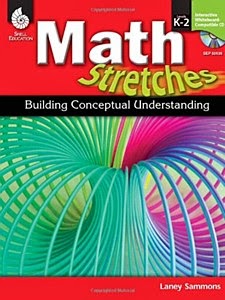
Fabulous Find: Math Stretches

A couple of summers ago, I heard about Laney Sammon's book Guided Math. I just knew I had to buy it and read it for myself. Guided math was something I always wanted to do, especially since I had been doing and loving guided reading for 10 years, but I just couldn't quite grasp how to get it up and running in my classroom. Her book was great and I really liked her idea of Math Stretches. They are short, simple math activities the kids do to "stretch" their brain into thinking mathematically.

http://www.amazon.com/Guided-Math-Framework-Mathematics-Instruction/dp/1425805345

Well fast forward to about a month ago. I read (probably on a blog, or Pinterest) that Ms. Sammons came out with a book that focused just on Math Stretches and ordered it immediately (don't ya just LOVE Amazon Prime:). The book I ordered is geared to K-2 and it is fabulous!! Ms. Sammons has GREAT math stretches in all areas of math (number knowledge, algebraic operations, measurement, geometry, data). I have it ready to go when my students arrive in the morning, and we discuss the stretch at the beginning of our math block. She has everything laid out in this book and even when I have a sub, the sub can read the explanation and what the students are to do. Something I don't have to write in sub notes!
http://www.amazon.com/Math-Stretches-Building-Conceptual-Understanding/dp/1425806368/ref=sr_1_1?s=books&ie=UTF8&qid=1391814122&sr=1-1&keywords=math+stretches+k-2

This is the K-2 book I have. She has them available in 3-5, and 6-8 also. 
 I HIGHLY recommend it! 


Two-Word Winter Poems


If you have never tried writing two-word poems with your kids, they are a great for any age!  What's so nice about two-word poems? The format is EASY, a two-word poem can be written about ANYTHING, and writing them is a great opportunity for students to use strong adjectives and verbs (personification, too--though I do not use that term with my second graders). Courtney and I just got done doing two-word winter poems with our kids.  The first step was for students to brainstorm any words/ideas that came to their minds when they thought of winter. The lists were long. To reinforce the use of adjectives, we worked as a class to generate some strong adjectives that could be used to describe various nouns that students had on their lists.  Students circled all of the nouns on their lists, and this was a reminder that adjectives could be used to describe those winter ideas (if they chose to include them in their poems).  We also talked about using strong verbs and describing those actions.  We have not worked specifically on the term adverbs as of yet, but this was an introduction to this concept.  The next step was for each student to choose a focus for his/her poem.  Some choices were snow (in general), fun in the snow, snowflakes, bundling up, a fireplace, and hot cocoa.  Finally, students were off and working on their poems.  The rules--two-words per line with a minimum of 5 lines. Oh--and their ideas must "fit together" and make good sense.  I did not provide a lot of guidance during the writing stage.  Students' creations were fabulous! They were perfect to accompany our wintery tree artwork.


Eats, Shoots, and Leaves: Mini-Lesson & Class Book


Many of you have probably seen this mentor text for teaching conventions (use of commas) in writing--Eats, Shotts, and Leaves by Lynne Truss.  I saw a need for more work with using commas consistently and correctly to separate words/ideas in a series within the context of student's writing, so I decided to use this text for a mini-lesson.  It's a fun, yet useful, presentation of how important it is to use commas correctly.  While it presents the use of commas in various ways, other than to separate words/ideas in a series, its illustrations help students understand the purpose of punctuation--to tell their readers how to read their writing.

Here's an overview of the mini-lesson:

Read aloud text.  Students will laugh! Stop to discuss why the text is so funny.  Students will realize how one small thing, a comma, can change how a simple sentence is read. Reassure students that they do not need to know all of the different ways commas are used in the text. Yet, let them know they will need to use commas correctly to separate words/ideas in a series.  Ask students if they remember a page in the text where the author used this skill.  Revisit these pages. Tell students they will get a chance to use commas in this way in the creation of a class book. Project pages from the text that are specific to the skill being taught.  Then give each student a prompt such as, My __________ loves to...  Model using the prompt to write a sentence with the use of commas.  Example: My grandson loves to drink chocolate milk, play Batman, and listen to me read.  After students have finished writing their sentences, tell them to close their eyes and picture what is happening or being described.  Then allow students to illustrate. Compile student work into a class book for future enjoyment and easy reference.

Here are some pages from our class book...


Math Bags
One night, when reading the many wonderful blogs I visit, I came across First Grade Buddies. I read how they incorporate Math Bags during their math block. Now I spend A LOT of my nights and weekends printing, laminating, and cutting activities for my math workstations, and was looking for something that was simple, but still reinforced the math skills my students need. Their Math Bags were just what I was looking for. They have created math skill activities that my students can do independently. I love how the directions for students are easy to follow, I love that I don't have to use colored ink, I love that they reinforce skills we have worked on in the classroom, and I love that they meet Common Core standards.  They are a win, win with me!
  
Math Bags for 2nd Grade THE COMPLETE SET (30+ Common Core

I purchased the 2nd grade set, but I  know they have them available for Kindergarten and 1st also.  I purchased the seasonal Valentine's Day version too!

Math Bags for 2nd Grade: Valentine's Day Version! (10 Math


New Clipart

Another snow day this week meant some extra time to create some new clipart!  

Check them out in my Graphics by Sarah Beth TpT Store!

http://www.teacherspayteachers.com/Product/St-Patricks-Day-Clipart-Whimsical-Borders-Shamrocks-1098659http://www.teacherspayteachers.com/Product/Read-Across-Amercia-Whimsical-Scallop-Circle-Borders-Clipart-Borders-1083610

Feel free to link up your fabulous finds! Have a wonderful weekend!

Sunday, February 2, 2014

Must Read Mentor Text Linky--Social Studies with a FREEBIE!

It's Sunday and time for Collaboration Cuties Must Read Mentor Text Linky!  Today's topic is Social Studies, so it's a perfect time for us to share some texts we used this past November that we did not have time to blog about...


Samuel Eaton's Day: A Day in the Live of a Pilgrim Boy  and Sarah Morton's Day: A Day in the Life of a Pilgrim Girl by Kate Waters were excellent texts for helping our students understand the roles and responsibilities of Pilgrim boys and girls.  The knowledge gained from exploring both texts was then compared to the roles and responsibilities they have today.  The two texts were perfect for reading aloud because the vocabulary and readability of each is "above" most of our students' independent reading levels.

The following outlines the activities we used before, during, and after the read alouds:

Before Reading:
Essential Question:  We presented students with an essential question that guided their exploration of both texts--How do your rules and responsibilities as a child today compare with a Pilgrim boy or girl?
Previewing Text: Identify title, author, and genre.
Anticipation Guide: Students independently completed and we shared out as a class.  This was a means of getting students thinking about key ideas related to the essential question.
Roles & Responsibilities Sort:  Students worked in groups of 2-3 to complete a roles and responsibilities sort.  Students had to work collaboratively and come to a decision where to place each card.
Vocabulary Knowledge Rating Scale:  Students completed this vocabulary activity using the Think-Pair-Share format.  Students rated their knowledge, paired with another students to share their knowledge, and then we shared our knowledge as a class.


During Reading: 
Roles & Responsibilities Reflection: During read alouds, we tied our pre-reading sorting activity to what was presented in the texts.  Connections were made as students discussed their lives in comparison to that of a Pilgrim boy or girl.
Revisiting Knowledge Rating Scale: We stopped to discuss words included on the knowledge rating scale and related our knowledge to how the words were used in context.  Students discovered that several words had multiple meanings.

After Reading:
Roles & Responsibilities Re-Sort: Students worked in small groups to complete the sorting activity we did before reading.  This was a means of reflection and assessment as students used the knowledge they gained from read alouds.
Revisiting Anticipation Guide:  As a class we discussed our misconceptions, things that surprised us, and some stereotypes that were shared about boys and girls.
Essential Question Graphic Organizer: Students self-selected two aspects of life (e.g., chores, school, clothing, etc.) and compared their life to that of a Pilgrim boy or girl.
Writing: Students completed graphic organizer was used as a guide for writing an informational/comparison essay.


 Pilgrim craftivity used to hold student writing by A Cupcake for the Teacher


Thanks to Collaboration Cuties for the opportunity to link up! Visit them to read about more social studies mentor texts...

http://collaborationcuties.blogspot.com/2014/02/katies-trunk-integrating-social-studies.html

All the best for an enjoyable week!

Tuesday, September 24, 2013

Traits Tuesday -- ANYTHING GOES!

 
Weighing in a little late in the day for our new linky--Traits Tuesday... This week's topic is ANYTHING GOES!

I have chosen to share a wonderful idea that I found on Make, Take & Teach from back in 2012--focus sticks.

The picture comes directly from Julie's post on Make, Take & Teach.

I found this idea some time ago and will be making some of these goodies soon.  Before I do, I am going to have my students brainstorm some picture icons to represent each of the traits we focus on for much of the first half of the year--ideas, organization, and conventions.  I will then create a cup of focus sticks that will be housed in the writing center for students to use as they are writing and editing.  Love this idea!  I think having this visual/kinesthetic item will help guide and motivate students.  I will post a picture of our finished focus sticks after doing some further work with my students... :0) Fly on over to Make, Take & Teach to learn more!

Join us in the learning fun and link up your ANYTHING GOES traits ideas for this week's Traits Tuesday!


Just grab our button, create a post, and stop back to link up!


Tuesday, September 17, 2013

Traits Tuesday - Best Traits Lesson


It's Traits Tuesday, and today's topic is Best Traits Lessons...


We have spent the past few days of school really diving into the writing trait, ideas.  Through my years of teaching primary students, I find that it is difficult for the majority of them to come up with off-the-wall, imaginative ideas (typically my higher level students are able to do this).  So because of this, we have focused a lot on our own experiences and writing from the heart. 

Author by Helen Lester is a true story about how Lester became an author. She tells of her experiences growing up and how writing wasn't always easy for her. I like how students can see that even people who make their lives writing books sometimes have difficulty getting ideas, but one can always look at things happening in their lives or interests to spark some ideas.

I usually read this book a couple of days after we have talked about ideas so that students are a little familiar with the trait. After reading the story, I begin modeling a writing about my own life. We then discuss what our ideas are that we would like to write about for the day. This keeps kids focused and on track. If I ever have a child that says, "I don't know what to write about", I tell them I will give them more time and come back to them when everyone else has shared their ideas. Usually at this point, they've thought of an idea from listening to their classmates. If they still are unable to come up with an idea, I give them 3 choices of ideas they can write about. This is the child that I will work with one-on-one, during conference time, to make a list of ideas from their interests. They keep this list in their writing binder for future reference.


Hope you can join in to share your best traits lessons! We would love to have you link up for Traits Tuesday!

Monday, September 9, 2013

Traits Tuesday - Teaching the Traits Mentor Texts


Today's Traits Tuesday topic is Teaching the Traits Mentor Texts...


The first trait I start off introducing is ideas.  I told my students just the other day that if I had a nickel for every time I heard a student say, "I don't know what to write about" in my 13 years of 2nd grade, I would be a millionaire!  So we have been working with where to get ideas and there are two books that I would like to share with you:)


Flip's Fantastic Journal by Angelo DeCesare is one of the best books ever!  My students L-O-V-E this book! It goes great with the writing trait of ideas because at the beginning, Flip doesn't like to write.  I typically have a handful of kids who do not like to write, therefore they say they don't have anything to write about. We learn that Flip has a pretty ordinary life, but with a little creativity and imagination his feelings about writing take a drastic change!


The second book I like to use with the writing trait, ideas, is The Best Story by Eileen Spinelli (don't you just love her books?!?)  In this story, the narrator (the little girl) wants to enter a writing contest and takes advice from her family members on what is included in the best story. After putting all of their ideas together, she realizes (with the help of her mother) that she needs to write with her heart. 

After I read this story, we create a heart map together. I got this great one from 3rd Grade's a Charm.


Interested in linking up your traits mentor texts? Just grab our button, link back to us, and link up to your post below.  You can also learn more about our Traits Tuesday linky by clicking here! We look forward to reading about the mentor texts you like to use to teach the traits.
 

Tuesday, September 3, 2013

Traits Tuesday - Must Have Trait Resources


It's week two of Traits Tuesday---Must Have Traits Resources!


A few years ago I started researching some resources to use in my classroom to help me teach the 6 traits of writing during Writer's Workshop. I came across some great ones that I would like to share with you:)

6 + 1 Traits of Writing: The Complete Guide For Primary Grades by Ruth Culham does an amazing job of helping teachers implement the traits. Included in this book are mentor texts you can use when teaching each trait, and scoring guides that are kid-friendly.

6 + 1 Traits of Writing: The Complete Guide for the Primary Grades
This website is full of resources, lessons, and mentor texts that teachers can use when teaching the traits. I love this site. It does a lot of the "thinking work" for me. I just look for the trait I am teaching, find some lessons, and, boom, done!  


A couple of years ago I made the switch from fifth to second grade.  I had a lot of experience teaching Writer's Workshop infusing the traits with older students---SO this year I set a goal to begin focusing on traits in the the Writer's Workshop setting with my second graders.

One resource that was extremely helpful when I taught fifth grade was Ralph Fletcher and JoAnn Portalupi's Craft Lessons: Teaching Writing K-8, so I recently began to look at this resource again--specifically the K-2 section.  This is a MUST HAVE for any teacher of writing. To learn about the second edition of Craft Lessons, visit Ralph Fletcher's website. For a substantial peek into this resource, click the cover below.


The "traits" of writing are not specific to one program.  An author's writing is strengthened through word choice and sentence fluency.  An author's voice "speaks" to us.  Organization is always important as a writer conveys his/her ideas, and so on. SO please feel free to share the resources you use to help develop/strengthen any of these areas--ideas, organization, word choice, sentence fluency, conventions, voice, and presentation.

We look forward to learning about the writing resources you are using! Simply save our button and use it to link back to us in your post.


Have a wonderful week!